



COMMENTARY
Another opportunity for India to advance the public interest in research: Copyright reform and a trust label
John Willinsky
Published online first on October 16, 2026. DOI:10.20529/IJME.2026.062Abstract
Open access adoption rates are slowing down due to the growing expense associated with it, and a lack of peer review transparency. To address this, I propose two measures with a special focus on the Indian context. The first entails a copyright reform that addresses the distinctive economy of research publications, utilising statutory licensing to support universal and sustainable open access. This licensing will require research publications to be open access, while relying on the Commercial Courts of India to set a fair price for publishers to charge institutional research users, such as universities. The second measure introduces a Publication Facts Label (PFL) on journal publishing platforms that will provide readers with ten verifiable data points on each research article’s adherence to scholarly publishing standards. The PFL is currently being rolled out for journals using the Open Journal Systems (OJS) platform, with discussions underway on its potential as an industry-wide standard for research transparency and trust.
Keywords: scholarly communication, copyright reform, research integrity, open access
Introduction
For more than half a century, India has been a leader in generic drug development, vastly increasing access to needed medications and treatments around the world. India passed The Patents Act 1970 out of a belief that the law “should act as [an] instrument to promote public interest” [1]. The country has since grown into the “Pharmacy of the World” and is a leader in vaccine production. This commentary presents a further appeal to India to promote the public interest in research, a related field of intellectual property. I also propose that India’s academic community consider, in a spirit of leadership and innovation, two measures that hold promise for facilitating and improving open access to research.
The first measure entails instituting a digital-era updating of copyright law for research publications to support universal and sustainable open access. This will apply a legal remedy to current concerns over the pricing and pace of open access to research. This calls for a lobbying effort by the academic community to bring about positive legislative change in research that advances the public interest.
While the first measure requires legal reform to expand open access, the second calls for journal editors, publishers, and societies to improve the transparency and trustworthiness of open access, essential features for moving towards universal and sustainable open access. These two measures will expand and strengthen open access, which is now recognised as the best means for sharing research and scholarship. More specifically, the second measure will enable readers to see the publishing standards applied to research articles with a label displaying ten items or data points for the publication.
These two measures address different but related challenges to the promise that open access holds for the progress of science. They are both no less a matter of medical ethics, although open access extends to all types of research. I am proposing, in effect, a viable, if by no means easy, path to ensuring sustainable free access to the biomedical literature, alongside a measure to provide readers with assurances of the literature’s adherence to scholarly publishing standards. I believe these two approaches compare favourably with the current slow and increasingly expensive rate of open access adoption, which is undergoing something of an integrity crisis.
Copyright reform can foster universal and sustainable open access
Let me start with the case for reforming copyright law to better serve research publications. The twenty-first century has seen researchers, librarians, funders, publishers, and platform developers recognise the contribution that open access to research can make to their work. Although it took a pandemic for a consensus to be reached among scholarly publishing stakeholders on the value of open access [2], the scholarly tradition is rich with earlier examples of a free and open sharing of knowledge across borders and languages, perhaps most notably among Indian, Greek, Islamic, Latin, and Judaic scholars spanning the period 800-1200 CE, once misleadingly characterised as the “Dark Ages” [3]. Now that a similarly diverse community is looking for ways of increasing open access to global research, we would do well to coordinate our efforts to advance this new approach to sharing knowledge, while taking inspiration from India’s record of engaging in intellectual property reform for the public good.
At this point, the global South has demonstrated that open access can serve as a digital-era publishing standard. We have experienced this at the Public Knowledge Project (PKP), a joint research and development initiative of Simon Fraser University and Stanford University. Our open-source platform, Open Journal Systems, is now used by more than 60,000 journals in 156 countries (1,600 in India, including this one) for open access publishing. At issue, however, is how many corporate and large society publishers in the global North — such as Elsevier, Wiley, and American Chemical Society — have found a profitable route (and in the case of bad actors, a fraudulent path) to open access by charging authors Article Processing Charges (APC) for open access. For the corporate sector, this is often combined with Read & Publish Agreements that link subscriptions and APCs.1 These agreements are making for an expensive and slow transition to open access, with recent signs that their popularity with libraries is declining [4]. At the current rate of growth, in fact, it will take decades to bring about universal open access, even as open access expenses for authors and institutions increase [5].
It is time, I believe, to consider strategies that can deliver universal and sustainable open access in a timely manner. I propose that scholarly publishing needs to do no more than other cultural industries have done in adjusting to the digital era. The video, music, gaming, phone, and TV industries have successfully lobbied for internet-aligned copyright changes in countries around the world. Scholarly publishing has not seen widespread copyright changes in the 21st century, apart from the “Secondary Publishing Rights” legislation that has now been passed in eight European countries. However, these secondary rights depend on researchers providing open access, if only to the final draft of government-sponsored research after an embargo period [6]. This does not offer a path to universal open access, nor provide any means of regulating the cost of open access. This lack of a means of arriving at a fair price for open access publications is also a problem with Creative Commons licensing, which has otherwise been successfully introduced worldwide as a voluntary means to ensure that open access publications can stay open. These limits show how constrained our progress continues to be in reaching the agreed upon goal of universal and sustainable open access.
Thus, I welcome this opportunity to recommend that India introduce a form of statutory or compulsory licensing into its copyright legislation that bears exclusively on research publications. This will ensure open access for research publications at a fair market price in India. Such licensing is already a key part of India’s Patents Act of 1970, in which the Controller can intervene when “the patented invention is not available to the public at a reasonably affordable price” [1]. The Copyright Act 1957 contains provisions for statutory licensing (Sections 31 to 31-D), which I am proposing should now be applied to a new category known as “research” [7]. The Act currently lumps research publications under “literary works” in Section 13(1)(a), and to achieve open access for research alone (compared to other literary works), a distinct category of work is required. India can thus start a global trend, inspiring other jurisdictions, by applying a proven copyright remedy to scholarly publishing which has failed, so far, to deliver a public good at a fair price.
In applying statutory licensing to research publications, India’s Commercial Court (following the Tribunals Reforms Act, 2021) would be called upon to hear from all parties on a periodic basis, resulting in the setting of a fair market price. Institutions, funders, and other major users (potentially including AI companies and pharmaceuticals) will pay this fair price to publishers for ensuring that all research publications are open access. The Court would hear from librarians, researchers, funders, and publishers on what is sustainable [8]. All parties will likely allow, for example, Elsevier and the American Chemical Society, some level of profit and surplus as they demonstrate investment in improved services. The entire process is a natural extension of the leadership that India has shown with its “One Nation One Subscription” (ONOS) policy [9]. On the question of the “research publications” to which the licensing applies, academic librarians would have to be involved in some form of a Research Publication Registry that ensures only trustworthy research qualifies.
Now it is worth noting that India’s Copyright Act 1957 includes a Fair Dealing clause that allows any work to be used for “private or personal use, including research” thereby excluding it from copyright protection for that purpose (Section 52). Additionally, India is a member of the Berne Convention for the Protection of Literary and Artistic Works, which contains the three-step rule that limits Fair Dealing exclusions to “a normal exploitation of the work and does not unreasonably prejudice the legitimate interests of the author” [10]. Fair dealing, however, protects certain uses of works for research purposes, rather than protecting access to research publications. Meanwhile, the Berne Convention, Article 9.2, emphasises that open access to research should not be treated as an exception, as it only extends “a normal exploitation of the work” to more people, and thus, greatly advances “the legitimate interests of the author.”
The music industry has already demonstrated how copyright reforms of this nature need only be introduced in one country for them to begin to spread globally. Such efforts are supported by the World Intellectual Property Organization (WIPO), and the World Trade Organization (WTO). Another factor making this copyright reform feasible is that more than enough money is already being spent world-wide on scholarly publishing [11]. Add to this how big and small publishers in the music industry have been happy enough with — which is to say have not substantially lobbied against — statutory licensing on a global basis for over a century [12]. Current library and funder payments to publishers might well provide a starting point. And while many of the details will require extensive analysis and treatment, I have prepared a book-length analysis of this reform proposal in an open access format with MIT Press [13].
Having demonstrated leadership in open patent reform and national publisher negotiations, India is well positioned to create model legislation designed to facilitate universal open access. It could also explore the Marrakesh Treaty of 2013 model, in which countries agreed in advance to implement a set of copyright reforms — affecting, in this case, the visually impaired — before 2016. This enabled the reform to unfold on an international scale from the outset [14].
In the context of India, I am tempted to suggest how the statutory licensing proposal aligns with the Delhi High Court’s recent ruling in favour of the scholarly publishers Elsevier, Wiley, and the American Chemical Society. This resulted in India’s loss of access to Sci-Hub’s massive repository of (illegally obtained) research articles [15]. That is, this legislative proposal recognises that Sci-Hub could never offer a viable route to open access because it is completely dependent on illegally exploiting the existing publishing structure to produce the literature it offers. I am proposing instead that the establishment of a legal means of directing the current support provided to publishers (while introducing checks and balances) towards the universal open access demonstrated by Sci-Hub would be widely used. I agree with Bhattacharya et al’s point in their recent analysis in this journal that “Sci-Hub may have been silenced, but its widespread adoption exposed the moral and structural failures of the current scientific publishing ecosystem and its legacy lies in igniting a necessary global debate” [16]. I would add to that debate by pointing to a legal and sustainable solution consistent with India’s earlier initiatives; and in support of their recommended “mandatory open access.”
At the very least, the Sci-Hub lawsuit is another reminder that scholarly publishing is due for a copyright update, so that the law works as well for 21st century open access as it does for the 20th century subscription model. After all, India’s Patent Act of 1970 has been updated repeatedly, and most recently in 2024. Much as the Patent Act created an alternative to Big Pharma monopolies, so comparable publishing monopolies would be addressed by introducing into copyright a statutory licensing of research publications, requiring both open access and fair compensation to its publishers, as determined by the Competition Courts. Researchers, libraries, and funders in various parts of the world are looking for a means of establishing universal and sustainable open access. India seems to be the right jurisdiction in which to initiate a model of copyright reform that others would soon adopt and follow. No other jurisdiction has India’s history of fearlessly defending the public good with the Patent Act of 1970 and instituting an ONOS policy, while facing the court-ordered exclusion of Sci-Hub, because Elsevier and the American Chemical Society thought it the right place to bring its battle with Sci-Hub.
When it comes to the scale of such legal reform, I draw inspiration from the recent and substantial changes to copyright in music. These have brought streaming services, such as Spotify, under the terms of statutory licensing in India in 2019, following the US Music Modernization Act 2018 [17]. Taylor Swift’s courageous withdrawal of her music from Spotify in 2014 contributed to US copyright change four years later [18]. Perhaps the Delhi High Court’s decision against Sci-Hub might prove the turning point for this public interest legal reform. If this call for legal reform resonates with some readers of this journal, perhaps the Indian National Science Academy or the Council of Scientific and Industrial Research could establish a committee to investigate how to better serve research publications and the public in India. And while the Indian academic community explores this legislative path to universal and sustainable open access, it might also consider how its journal editors, publishers, and societies can take steps to improve readers’ confidence in open access research.
A publication facts label can engender greater trust in open access
While copyright’s well-tested legal remedy of statutory licensing is available to support universal and sustainable open access, no comparable strategy is available for increasing trust in open access research publications. In fact, open access has, on occasion, been exploited in ways that can undermine our confidence in the resulting publications. Unscrupulous publishers have compromised peer review, for example, with an eye on collecting APCs, sometimes involving so-called journals created for this purpose and sometimes big traditional publishers [19, 20]. At the same time, new journals and publishers can face challenges in establishing trust in their adherence to publishing standards [21]. In both cases, the loss is borne by science. Although efforts at promoting research integrity have a mixed record [22], I think we can take a basic step, outlined below, by drawing on how public trust has been established by the food industry, through the use of informative labels. This is similar to the developments I’ve drawn on in music publishing, in proposing statutory licensing.
While the research integrity issues raised by paper mills and data manipulation are being addressed by several innovative approaches, the integrity measure I am proposing concerns transparency and verification around the reviewing and publishing process [23]. To that end, we at PKP have created a Publication Facts Label (PFL) that appears with each research article [24]. The PFL provides ten data points drawn from the publishing platform that can serve as trust indicators, supported by averages from other journals using the label (Figure 1). The label is modelled on the US Nutrition Facts label, which research demonstrates is consulted by the public, and for which the Food Safety and Standards Authority of India offers instructional materials [25, 26].
Figure 1. An example of the Publication Facts Label
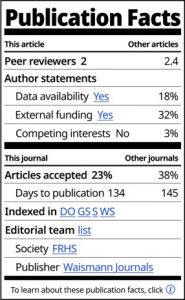
This open-source publishing plugin is designed to be installed in journals using the open-source OJS publishing platform. The PFL is intended not only as a guide for researchers, but to help educate the public about what distinguishes peer-reviewed research, which is increasingly available to them, from other sources of information. Trust in science and scientists, while still very high in India, is declining in the United States and elsewhere, even as growing open access adds to the academic community’s responsibilities in establishing public trust in its work [27, 28]. Feedback on the PFL’s clarity and elements has been collected not only from journal editors and researchers, but from science journalists, high school students, and their families, as it seeks to establish what distinguishes research from other information sources, with a full explanation of each element provided on the information page linked to the PFL.2
The Publication Facts Label appears on each research article’s landing page with data and links to sources; the “other articles” and “other journals” data is aggregated from journals using the label.
While more research will be needed on the use and value of the PFL as it is more widely implemented, it has been the object of Nature’s “Reader Poll” with 73% of 3,785 Nature readers thinking it “would be useful” [29]. At an open access publishers’ conference presentation that I gave in 2024, 72 of the 73 attendees thought it would be “a useful addition to journals.” On testing it in a pilot study with 130 journals, the PFL dropdown was not clicked often, but readers who self-identified as “public” ranked its value slightly higher (4.8/5) than “university” readers (4.4/5). As a result of the consultations, presentations, and testing, the PFL is now being released in multiple languages for journals using OJS. We also have discussions underway with publishers, platform developers, scholarly societies, and journal editors on the use of the PFL beyond OJS, about it serving as an industry-wide standard. I welcome contact from interested parties in this regard. The PFL is not, of course, hackproof (no technology is), but it does include verification strategies that raise the bar considerably for hackers. Nor are the PFL items fixed once and for all. We can see a larger community participating in the addition or deletion of PFL items, which might well involve decisions to employ AI integrity checks [30].
The importance of being able to establish research adherence to these standards is affected by the growth of open access and scholarly publishing, more generally. This growth follows from a near-doubling of higher education institutions in the global South during this century [31]. It means that good researchers can no longer rely in their literature reviews on only the familiar sources they have long known. With the growth of more globally comprehensive indexes, such as OpenAlex, and improved machine translation, researchers need to be able to consult with confidence a wider range of the world’s research results [32] . To be able to readily establish a study’s adherence to scholarly standards is an invaluable first step in ensuring that researchers can productively consult the global scale of today’s research.
Currently, we are asking the editors of journals using OJS to consider installing the PFL plugin. At the same time, we’ve been reaching out to 40 interested scholarly publishing organisations to work with their editors and editorial boards on a PFL integration into their platforms. There are also industry-wide organisations, such as the persistent-identifier organisation ORCID, that have expressed an interest in acting as a convener for managing the PFL. India’s academic community could advance its own and the public interest in research by promoting the adoption of the PFL by Indian journals. A hundred of those journals were among the first to adopt the PFL. If this spreads to a thousand Indian journals using OJS, it would help set this new standard for transparency and trust.
The two measures presented here, copyright reform and a publishing label, are intended to ensure that research in the digital era circulates for the benefit of all. These measures could contribute to the universality, sustainability, and trustworthiness of research access. My appeal to India’s academic community, especially in the case of copyright reform, is based on the country’s rightly proud record of leadership in supporting the public interest. Few would question today the extent to which India’s reform of patent law continues to promote that public interest worldwide. My hope is that India’s academic community will join us in finding ways of building on these ideas for copyright reform and trust labelling to champion the public interest in advancing the benefits of research.
Notes:
1 Read & Publish Agreements allow for an institution’s subscription fees for a series of journals to cover some proportion of its faculty’s Article Processing Charges levied to publish open access articles in those journals.
2 The PFL link leads to this page: https://pkp.sfu.ca/pfl-information/
Author: John Willinsky ([email protected], https://orcid.org/0000-0001-6192-8687), Khosla Family Professor Emeritus, Stanford University, California, USA.
Conflict of Interest: I have been closely associated with the Public Knowledge Project since founding the organisation in 1998.
Funding: Arcadia Fund and an anonymous Stanford University donor.
Acknowledgments: The research and consultation on copyright were supported by the Arcadia Fund, while the development of the Publications Facts Label is underwritten by an anonymous donor to Stanford University. I am also indebted to Subbiah Arunachalam for first introducing me to the Indian scholarly publishing community a quarter of a century ago. My thanks, as well, to the anonymous reviewers and editorial staff who helped me improve this Commentary. I would also note that Anthropic’s Claude-4-5-sonnet was used to proofread this Commentary, while Google’s Gemini guided my reading of Indian copyright law.
To cite: Willinsky J. Another opportunity for India to advance the public interest in research: Copyright reform and a trust label. Indian J Med Ethics. Published online first on October 16, 2026. DOI: 10.20529/IJME.2026.062
Submission received: October 9, 2025
Submission accepted: September 1, 2026
Manuscript Editor: Lubna Duggal
Peer Reviewers: Alastair Matheson and an anonymous reviewer
Copyright and license
©Indian Journal of Medical Ethics 2026: Open Access and Distributed under the Creative Commons license (CC BY-NC-ND 4.0), which permits only noncommercial and non-modified sharing in any medium, provided the original author(s) and source are credited.
References
- Government of India. The Patents Act 1970. New Delhi: Controller General of Patents, Designs and Trade Marks. 1970[cited 2026 Jun 8]; Sep 19. p. 64-65 Available from: https://ipindia.gov.in/frontend/pdf/patents/1_113_1_The_Patents_Act__1970___incorporating_all_amendments_till_1-08-2024.pdf
- Besançon L, Peiffer-Smadja N, Segalas C, Jiang H, Masuzzo P, Smout C, et al. Open science saves lives: lessons from the COVID-19 pandemic. BMC Med Research Method. 2021 Jun 5;21(1):117-135. https://doi.org/10.1186/s12874-021-01304-y
- Willinsky J. The intellectual properties of learning: a prehistory from Saint Jerome to John Locke. Chicago: University of Chicago Press; 2017[cited 2026 Jun 8], chapter 6. Open access. Available from: https://intellectualproperties.stanford.edu/book-chapters
- Pollock D, Michael A. Market sizing 2024: has OA hit a peak? Delta Think News & Views. 2024 Oct 22[cited 2026 Jun 8]. Available from: https://www.deltathink.com/news-views-market-sizing-update-2024-has-oa-hit-a-peak
- Piwowar H, Priem J, Orr R. The future of OA: a large-scale analysis projecting Open Access publication and readership. BioRxiv preprint. 2019 May 9. https://doi.org/10.1101/795310
- Lazarova A. Conceptualising the right to secondary publication. In: Sganga C, Synodinou EL, editors. Flexibilities in copyright law. London: Routledge, 2026[cited 2026 Jun 8]. Available from: https://ssrn.com/abstract=4934531
- Copyright Office, Govt of India. The Copyright Act, 1957, Act No. 14 of 1957. New Delhi: Copyright Office. [cited 2026 Jun 8]. Available from: https://www.copyright.gov.in/Documents/Copyrightrules1957.pdf
- Abowd D. Something old, something new: forecasting willing buyer/willing seller’s impact on songwriter royalties. Fordham Intell. Prop. Media & Ent. LJ. 2020[cited 2026 Jun 8];31:574. Available from: https://ir.lawnet.fordham.edu/iplj/vol31/iss2/5
- Lalita, Kumar N, Bhatt RK. One nation one subscription: an illusion or a reality? The Serials Librarian. 2025 Jul 5; 86:178-189. https://doi.org/10.1080/0361526X.2025.2520267
- World Intellectual Property Organization. Berne Convention for the Protection of Literary and Artistic Works. (WIPO.) As amended on 1979 Sep 28 [cited 2026 Jun 8]. Available from: https://www.wipo.int/wipolex/en/text/283698
- Schimmer R, Geschuhn KK, Vogler A. Disrupting the subscription journals’ business model for the necessary large-scale transformation to open access. Max Planck Digital Library, Munich; 2015. Available from: https://openaccess.mpg.de/2121558/MPDL_Open_Access_White_Paper
- Menell PS. Reflections on music copyright justice. Pepp L Rev. 2022[cited 2026 Jun 8];49: 533. Available from: https://papers.ssrn.com/sol3/Delivery.cfm?abstractid=3943710
- Willinsky J. Copyright’s broken promise: how to restore the law’s ability to promote the progress of science. MIT Press; 2023[cited 2026 Jun 8]. Open access. Available from: https://direct.mit.edu/books/oa-monograph/5507/Copyright-s-Broken-PromiseHow-to-Restore-the-Law-s
- Land MK. The Marrakesh Treaty as “bottom up” lawmaking: supporting local human rights action on IP policies. UC Irvine L. Rev. 2018[cited 2026 Jun 8];8:513. Available from: https://escholarship.org/content/qt6k16q0dp/qt6k16q0dp.pdf
- Mondal S. Indian court bans Sci-Hub, leaving some researchers worried. Chemistry World. 2025 Sep 10[cited 2026 Jun 8]. Available from: https://www.chemistryworld.com/news/indian-court-bans-sci-hub-leaving-some-researchers-worried/4022083.article
- Bhattacharya S, Bhattacharya K, Bhattacharya N, Bhattacharya N, Sharma D. Who really owns science? The Sci-Hub ban and the battle for scientific equity. Indian J Med Ethics. 2026 May 6. https://doi.org/10.20529/IJME.2026.030
- Joshi D. Breaking: the background music to Spotify’s India launch is a crucial legal battle on music copyright. SpicyIP [Blogpost]. 2019 Feb 28[cited 2026 Jun 8]. Available from: https://spicyip.com/2019/02/breaking-the-background-music-to-spotifys-india-launch-is-a-crucial-legal-battle-on-music-copyright.html#:~:text=Section%2031D%20of%20the%20Copyright,(Rules%2029%2D31)
- Clow CG. A Swift revolution: the value of music, artist remuneration, intellectual property and Taylor Swift’s disruption to the music industry to advocate for artist rights [MA thesis]. Auckland (NZ): University of Auckland; 2024. Available from: https://researchspace.auckland.ac.nz/bitstreams/8fcfaa9a-866c-45b9-95a0-03a8f255ae62/download
- Braillon A, Vinatier C, Naudet F. Weak campaign against predatory journals: structural issues. Indian J Med Ethics. 2026;Jan-Mar;11(1):30-34. https://doi.org/10.20529/IJME.2025.061
- 20. Guo M, Guo C, Cheng M, Bai L, Xing X, Zhao T, Lun Z. Analysis of batch retraction of papers by Hindawi journals. ChinaXiv. 2024[cited 2026 Jun 8]; 35(9):1169. Available from: https://chinarxiv.org/items/chinaxiv-202406.00021
- Khanna S, Willinsky J. What those responsible for open infrastructure in scholarly communication can do about possible predatory practices. In I. Fazel and P. Habibie, editors. Predatory practices in scholarly communication and publishing: causes, forms, implications, and solutions. Routledge; 2023[cited 2026 Jun 8]. Available from: https://preprints.scielo.org/index.php/scielo/preprint/view/3474
- Liu S, Yang Y, Li M. Interventions to promote medical research integrity: a scoping review. BMC Med Ethics. 2025;24;26(1):117. Available from: https://doi.org/10.1186/s12910-025-01275-5
- Hackett R, Kelly S. Publishing ethics in the era of paper mills. Biology Open. 9(10), 2020. https://doi.org/10.1242/bio.056556
- Willinsky J, Pimentel D. Publication facts label: a public and professional guide for research articles. Learned Publishing. 2024;1;37(2). https://doi.org/10.1002/leap.1599
- Kessler DA, Mande JR, Scarbrough FE, Schapiro R, Feiden K. Developing the “nutrition facts” food label. Harv Health Pol Rev. 2003[cited 2026 Jun 8];4(2):13–24. Available from: https://downloads.regulations.gov/FDA-2012-N-1210-0002/attachment_199.pdf
- Frohlich, X. From label to table: regulating food in America in the information age. Berkeley: University of California Press; 2023.
- Cologna V, Mede NG, Berger S, Besley J, Brick C, Joubert M et al. Trust in scientists and their role in society across 68 countries, Nat Hum Behav. 2025 Jan 20; 9:713–730. https://doi.org/10.1038/s41562-024-02090-5
- Kennedy B, Tyson A. Americans’ trust in scientists, positive views of science continue to decline. Pew Research Center. 2023; Nov 14. Available from: https://www.pewresearch.org/science/2023/11/14/americans-trust-in-scientists-positive-views-of-science-continue-to-decline/
- Reader Poll. What do you think about paper ‘nutrition labels’? Nature Briefing, Nature. 2024 Apr 26. Available from: https://www.nature.com/articles/d41586-024-01266-3
- Pellegrina D, Helmy M. AI for scientific integrity: detecting ethical breaches, errors, and misconduct in manuscripts. Frontiers in AI. 2025;8. https://doi.org/10.3389/frai.2025.1644098
- MacGregor K. Higher education report charts rise of the Global South. Uni World News, 2022 Mar 12. Available from: https://www.universityworldnews.com/post.php?story=20220311151815827
- Alperin J P, Portenoy J, Demes K, Larivière V, Haustein S. An analysis of the suitability of OpenAlex for bibliometric analyses. arXiv preprint. https://doi.org/10.48550/arXiv.2404.17663