RESEARCH ARTICLE
Integrating humanities into undergraduate medical curricula: A narrative review exploring focus areas, pedagogical design, and evaluation strategies
Punithalingam Youhasan
Published online first on August 4, 2026. DOI:10.20529/IJME.2026.046Abstract
Background: Humanistic medical education is crucial, yet its implementation faces challenges due to inconsistent curricular focus, pedagogical approaches, and assessment methods. This review aims to identify key focus areas, effective pedagogical strategies, and robust evaluation methods for integrating the humanities into undergraduate medical education.
Methods: A narrative review of MEDLINE publications from 2014 to 2024 was conducted, followed by a qualitative synthesis.
Results: The initial search in MEDLINE identified 16 potentially relevant articles. After comprehensively reviewing the initial catchment through several analytical phases, 10 articles were considered for the final review. In addition, another 7 articles were included through citation tracking. Key focus areas identified in the review included medical ethics, cultural competency, literature and narrative medicine, compassion, bias in healthcare and social and behavioural sciences. Humanities were typically found to be integrated as electives, with student-centred teaching methods demonstrating effectiveness. While humanistic outcomes are highly valued, the strategies used to assess them remain notably complex and underdeveloped.
Conclusions: This narrative review emphasises the need for standardised approaches to medical humanities, curriculum design, pedagogy, and assessment.
Keywords: humanities, medical humanities, medical education, curriculum, health professions education
Introduction
Medical humanities, an interdisciplinary field encompassing arts, humanities, and social sciences, enriches medical education by providing a comprehensive understanding of the human experience within the context of health, illness, and healthcare [1]. Integrating the humanities into undergraduate medical curricula is increasingly recognised as essential for developing a robust professional identity for future physicians [2]. As the field of medicine advances rapidly, it is imperative to foster not only the technical skills essential for clinical practice but also the ethical, cultural, and social understanding that underpin compassionate patient care [3]. This holistic approach is supported by a growing body of evidence demonstrating that a humanistic education can significantly enhance medical students’ interactions with patients, foster empathy, and deepen their understanding of the multifaceted human experience within healthcare settings [4].
The increasing commercialisation of curative medicine has led to dissatisfaction and declining public trust, accompanied by a perceived decline in compassion and empathy within medical practice, adversely affecting doctor-patient relationships [5, 6]. These factors may contribute to a growing public interest in seeking alternative medicine for health issues. To address these concerns, medical educators advocate for the humanisation of medical practice through the enhancement of medical humanities programmes [5].
Studies have consistently shown that medical students who engage with humanities disciplines, such as literature, ethics, and the arts demonstrate enhanced emotional intelligence and a more profound capacity for compassion [7]. These qualities are crucial for navigating the moral dilemmas and interpersonal challenges that are an inherent part of medical practice [8].
However, integrating humanities into the medical curriculum remains a complex and evolving landscape [9]. There is currently no universally accepted definition of “medical humanities”, leading to diverse interpretations and approaches within the field [10]. Furthermore, effective pedagogical methods and robust evaluation frameworks for these disciplines within medical education are still under development [5]. This review aims to explore key focus areas, effective pedagogical structures, and robust evaluation strategies that can successfully integrate the humanities into medical education, ultimately improving patient care and cultivating a more compassionate and empathetic healthcare environment.
Methods
For this narrative review, a comprehensive literature search was conducted within the MEDLINE database to identify relevant articles on medical humanities. The MEDLINE database was chosen due to its wide coverage of medical and health-related literature, its rigorous indexing utilising Medical Subject Headings (MeSH), and its accessibility.
A search algorithm incorporating MeSH terms and Boolean operators was developed to identify relevant studies systematically. The search strategy is detailed in Table 1.
Table 1. The MEDLINE search strategy and terms used
|
Search |
Algorithms |
Article (n) |
|
1 |
("Medical Humanities" OR "Humanities" OR "Medical Ethics" OR "Art in Medicine" OR "Narrative Medicine" OR "Empathy in Medicine") |
14543 |
|
2 |
("Undergraduate Medical Education" OR "Medical Curriculum" OR "Medical Students") |
58282 |
|
3 |
("Teaching Methods" OR "Curriculum Development" OR “Program Evaluation" OR "Assessment" OR "Evaluation") |
3620225 |
|
4 |
(Search-1) and (Search-2) and (Search-3) |
237 |
|
5 |
(Search-4) limited to (English language and full text and year="2014 – 2024" and "remove preprint records") |
16 |
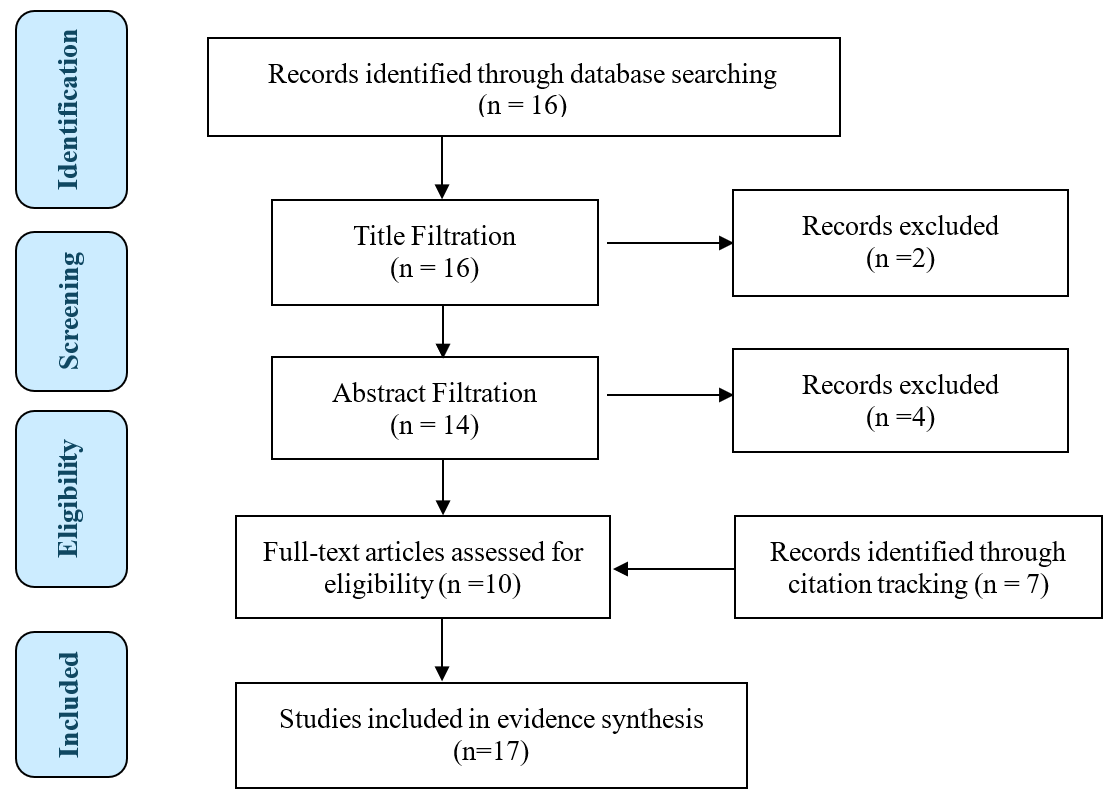
The identified studies underwent a rigorous four-stage screening process as depicted in Figure 1: (i) Title screening, (ii) Abstract screening, (iii) Full-text screening, and (iv) Citation tracking. Studies relevant to the integration of humanities in medical education or the implementation of humanities programmes among medical students were included for further consideration. Title, abstract, and full-text screening were conducted independently and systematically by the author. A comprehensive log of all reviewed studies, detailing reasons for inclusion or exclusion, was maintained. To ensure the objective selection of articles, this log was cross-checked by two content experts in medical humanities and medical education. Any disagreements regarding study inclusion or exclusion were resolved through discussions between the author and the experts.
Subsequently, a qualitative content analysis was conducted on the selected articles to extract relevant information [11]. This analysis followed the three-step framework described by Elo and Kyngäs [12]: Preparation, Organisation, and Reporting. The preparation phase involved systematic data extraction, guided by the study’s aim and focusing on three pre-defined themes: focus areas, pedagogical design, and evaluation strategies. The organisation phase entailed categorising the extracted qualitative data under these three themes. To achieve this, the author meticulously read the extracted data line by line to identify emergent codes that succinctly captured the meaning of the text. These codes were then grouped under their respective thematic categories (see Supplementary File 1). To enhance objectivity and reduce potential bias from single-author analysis, a systematic and reflexive approach was used. Clear coding rules were defined based on the review question (How are the humanities integrated into undergraduate medical education in terms of focus areas, pedagogical strategies, and evaluation methods?), and an analytic memo was maintained to document coding decisions and theme development. This ensured transparency and consistency in the analysis process. Finally, the reporting phase involved synthesising the aggregated codes and themes to construct a comprehensive narrative addressing the aim of the review.
Results and discussion
An initial search of the MEDLINE database yielded 16 potential articles. After screening titles and abstracts, six articles were excluded as they fell outside the scope of the review. The remaining ten articles were subjected to a full-text review. An additional seven potentially relevant studies were identified through citation tracking. Following a comprehensive review, a total of 17 articles were included in the data synthesis.
Of the 17 included articles, the majority originated from the USA (n=7), with six conducted at public research universities. Supplementary File 2 provides a detailed overview of these 17 articles included in the evidence synthesis.
Focus areas of the humanities in medical educationThe selected studies reported specific curricular contents to be focused on the medical humanities for undergraduate medical education. These were:
“Medical ethics” is an important subject for orienting undergraduate medical students to explore the role of the humanities in developing ethical reasoning and decision-making skills [13]. It is also important to consider cultural competency in maintaining a doctor-patient relationship to discuss how the humanities can foster cultural sensitivity and awareness of health disparities [5, 14].
Inclusion of “Literature and Narrative Medicine” helps to discuss how literature can enhance empathy, emotional intelligence and understanding of patient experiences [14, 15]. Compassion, which is the ability to recognise and deeply understand the suffering of others, coupled with a genuine desire to alleviate that suffering, is indispensable to the medical humanities [6].
“Bias in healthcare” is a crucial component in the medical humanities curriculum because it addresses critical issues related to equity, ethics, and professionalism in medical practice [16]. Two studies included in this review highlighted the significance of incorporating social, psychological, and behavioural dimensions and communication skills within the scope of medical humanities [3, 17].
Additionally, social studies, the history of medicine, and the interpretation of literature are recognised as integral components of medical humanities [17]. The visual and performing arts are also components of medical humanities, as they can enhance observation skills, diagnostic reasoning, communication, teamwork, and empathy [18]. Lastly, in medical humanities, it is essential to explore strategies for mitigating physicians’ burnout in healthcare settings [5].
Pedagogical structuresAnalysis of the current literature review highlights key sub-themes across selected studies, including the predominant pedagogical methods and class sizes utilised, the strategic integration and frequency of humanities content within the curriculum, and the varied backgrounds and roles of facilitators. Furthermore, the literature offers valuable suggestions for enhancing the successful implementation of these vital programmes.
Pedagogical approaches and class sizeCase-based small-group workshops have emerged as a prominent instructional approach in delivering medical humanities within undergraduate medical education [13]. These workshops often included structured elements like clinical case discussions, pre-reading assignments, and a combination of online and face-to-face lectures [13]. Facilitators in these settings actively encouraged participants to share their personal experiences relevant to the medical humanities. This study revealed that participants perceived case-based learning as an effective pedagogical method [13].
While the traditional lecture format was less frequently employed, student-centred approaches were seen to be widely adopted [15]. These included small-group workshops, writing-based instruction, seminars, case-based discussions, problem-based learning, role-modelling, interactive videos, role-play, and simulations [14]. Furthermore, these instructional methods integrated peer teaching and interprofessional approaches, requiring students from diverse professional backgrounds to collaborate on shared tasks and exchange field-specific perspectives [14]. Notably, while “drama and theatre” have been recognised as impactful methods for delivering medical humanities, their practical application remains relatively infrequent [14].
The medical humanities have predominantly been delivered in traditional classroom settings rather than in clinical or community environments [18]. E-learning platforms have played a role in facilitating the sharing of learning materials and enabling effective teacher-student interaction [14].
Curriculum integration and frequencyMost of the selected studies reported that the medical humanities were offered as elective course, with some institutions incorporating them into extracurricular activities [18, 19]. Another study emphasised three critical considerations for curricular implementation: (i) the integration of the humanities component early in the medical curriculum; (ii) the absence of a standardised curriculum for medical humanities necessitates careful consideration of contextual and cultural factors during curriculum planning; and (iii) the gradual introduction of medical humanities in a “‘piecemeal’ manner, prioritising content over process” [5, 20].
Facilitator background and roleThe involvement of facilitators from diverse backgrounds significantly enhanced the effectiveness of medical humanities delivery [18]. These facilitators included medical or healthcare lecturers, humanities specialists, museum educators, musicians, artists, and hospice staff [18].
Enhancing implementationThe successful implementation of medical humanities in undergraduate medical programmes could be further enhanced by several strategies. These include: (i) providing staff development or orientation programmes focused on the humanities; (ii) enabling medical students to shadow doctors who address medical humanities issues; and (iii) offering opportunities for medical students to participate in ethics and humanities committee meetings [5, 14].
Evaluation strategiesThe literature review revealed a significant gap in the assessment of medical humanities courses among medical students. Isaac argued that traditional assessment methods may not be suitable for evaluating the intangible aspects of medical humanities [5]. However, the need for clear and meaningful metrics to assess these competencies is undeniable. While a few studies explored potential assessment mechanisms, these findings were limited by the heterogeneity of teaching and assessment practices across different countries [3, 14] . Some studies incorporated a variety of assessment methods, including writing assignments, artistic expression (drawing, acting), reflective exercises, and reading comprehension [18]. However, all assessment attempts relied heavily on student feedback and retrospective interviews to gain deeper insights into the effectiveness of medical humanities curricula and identify areas for future improvement [14].
The impact of medical humanities workshops has been evaluated through pre- and post-knowledge tests [13]. While developing a comprehensive assessment system for medical humanities presents significant challenges, it is not an impossible task [19]. Given the powerful motivational role of assessment in medical education, educators can and should implement formative assessment strategies in various forms to provide constructive feedback and guide student learning [14].
Challenges reported in incorporating the humanities into the medical curriculumThe medical humanities curriculum often remains marginalised within medical education due to a lack of standardised focus areas, pedagogical approaches, and evaluation methods. The existing medical curriculum is already heavily burdened with pre-clinical, para-clinical, and clinical subjects. Allocating adequate space and time for medical humanities often necessitates difficult compromises and trade-offs within the existing curriculum [5, 21].
Effective integration of the humanities into the medical curriculum requires significant resources. Many medical faculty members lack formal training in humanities disciplines. Addressing this gap necessitates either providing comprehensive training to existing faculty or recruiting qualified humanities scholars, both of which can be resource-intensive endeavours [3, 5, 14].
Simply introducing humanities content into the medical curriculum is insufficient. Effective integration requires establishing clear and meaningful connections between the humanities and biomedical sciences, demonstrating their relevance to clinical practice. Failure to establish these connections may lead medical students and faculty to perceive the humanities as less relevant or important than traditional biomedical subjects, thereby fostering resistance to their inclusion [3, 22].
Implications for practiceThis review offered several important insights for integrating the humanities into undergraduate medical education. To meaningfully incorporate medical humanities, institutions need to expand their curriculum. This expansion should thoughtfully include disciplines such as narrative medicine, the visual and performing arts, and the social aspects of healthcare, in addition to medical ethics. Using student-centred pedagogical approaches, particularly case-based workshops, reflective writing, and experiential learning, is vital for enhancing meaningful student engagement. Early and context-sensitive incorporation of humanities concepts into the core curriculum is suggested to maximise their relevance and impact. Equally important is the participation of facilitators from diverse academic and professional backgrounds, supported by comprehensive faculty development initiatives. Innovative formative assessment methods tailored to humanities education’s affective and reflective learning outcomes are also crucial for reinforcing student learning and programme effectiveness.
Limitations of this studyThis review primarily used the MEDLINE database. While this is a key resource for biomedical literature, relevant studies indexed in other databases like Scopus or Web of Science might have been missed. The data extraction and categorisation were conducted by a single author. While steps were taken to ensure a systematic and well-documented analytical process, the absence of a second author for cross-checking is a limitation.
Conclusion
The significance of the humanities within the medical curriculum is steadily increasing. However, a robust theoretical framework for medical humanities, encompassing focus areas, pedagogical design, and assessment strategies, remains largely underdeveloped. Notably, effective assessment strategies for medical humanities education are scarce, necessitating the development of rigorous evaluation methods. The predominant pedagogical approaches observed in medical humanities delivery are student-centred.
The review proposes several strategies for the thoughtful integration of medical humanities into medical education. These include: vertically integrating humanities concepts instead of offering isolated modules; training faculty in humanities to enhance the teaching-learning process; leveraging arts and humanities for interprofessional initiatives; offering experiential learning opportunities through innovative pedagogies; and addressing ethical challenges.
Several challenges have been identified in the implementation of medical humanities curricula, including time constraints, curriculum overload, resource limitations, resistance from stakeholders, and the development of effective assessment strategies. The findings of this review can provide valuable insights to inform and facilitate the successful integration of the humanities within medical education.
Notes: References 23, 24 and 25 are part of Supplementary File 2.
Author: Punithalingam Youhasan (youhasanp@esn.ac.lk, https://orcid.org/0000-0002-3435-7839), Department of Medical Education & Research, Faculty of Health-Care Sciences, Eastern University, Sri Lanka. Rainwood Estate, Pillayaradi, Batticaloa, Post Code 30000, SRI LANKA.
Conflict of Interest: None declared Funding: None
Acknowledgement: The expert guidance of Dr Sivanjali Myuran and Ms M. A. F. Sihnas during the article selection process is gratefully acknowledged.
To cite: Youhasan P. Integrating humanities into undergraduate medical curricula: A narrative review exploring focus areas, pedagogical design, and evaluation strategies. Indian J Med Ethics. Published online first on August 4, 2026. DOI: 10.20529/IJME.2026.046
Submission received: December 31, 2024
Submission accepted: October 22, 2025
Manuscript Editor: Olinda Timms
Peer Reviewers: Two anonymous reviewers
Copyright and license
©Indian Journal of Medical Ethics 2026: Open Access and Distributed under the Creative Commons license (CC BY-NC-ND 4.0), which permits only noncommercial
and non-modified sharing in any medium, provided the original author(s) and source are credited.
References
- Hoang BL, Monrouxe LV, Chen K-S, Chang S-C, Chiavaroli N, Mauludina YS, et al. Medical Humanities Education and Its Influence on Students’ Outcomes in Taiwan: A Systematic Review. Front Med. 2022 May 16;9. https://doi.org/10.3389/fmed.2022.857488
- Leedham-Green K, Knight A, Iedema R. Developing Professional Identity in Health Professional Students. In: Nestel D, Reedy G, McKenna L, Gough S, editors. Clinical Education for the Health Professions: Theory and Practice. Singapore: Springer Singapore; 2020. p. 1-21.
- Petrou L, Mittelman E, Osibona O, Panahi M, Harvey JM, Patrick YAA, et al. The role of humanities in the medical curriculum: medical students’ perspectives. BMC Med Educ. 2021 Mar 24;21(1):179. https://doi.org/10.1186/s12909-021-02555-5
- Rosenthal S, Howard B, Schlussel YR, Herrigel D, Smolarz BG, Gable B, et al. Humanism at Heart: Preserving Empathy in Third-Year Medical Students. Acad Med 2011 Mar;86(3): 350-8. https://doi.org/10.1097/acm.0b013e318209897f
- Isaac M. Role of humanities in modern medical education. Curr Opin Psychiatry, 2023 Sep 1;36(5):347-51. https://doi.org/10.1097/yco.0000000000000884
- Reichman J, Palfreyman L, Babcock O’Connell C. Assessment of Compassion in Physician Assistant Students. J Physician Assist Educ. 2021 Jun 1;32(2):108-12. https://dx.doi.org/10.1097/JPA.0000000000000357
- Srinivasan S, Rachoin J-S, Gentile M, Hunter K, Cerceo E. Empathy and cultural competence remains stable for medical students: do the humanities have an effect? BMC Med Educ. 2024 Nov 13;24(1):1301. https://doi.org/10.1186/s12909-024-06040-7
- Malpas P, Jowsey T. Humanities for medical students: essential to their cultural competence and patient-engaged practices of care [version 1]. MedEdPublish. 2018 Sep 7;7(202). https://doi.org/10.15694/mep.2018.0000202.1
- Siddiqi DA, Miraj F, Munir M, Naz N, Shaikh AF, Khan AW, et al. Integrating humanities in healthcare: a mixed-methods study for development and testing of a humanities curriculum for front-line health workers in Karachi, Pakistan. Med Humanit. 2024 Aug 14;50(2):372. https://doi.org/10.1136/medhum-2022-012576
- Adachi T. Medical Humanities. In: ten Have H, editor. Encyclopedia of Global Bioethics. Cham: Springer International Publishing; 2014. p. 1-11.
- Youhasan P, Chen Y, Lyndon M, Henning MA. Exploring the pedagogical design features of the flipped classroom in undergraduate nursing education: a systematic review. BMC Nurs. 2021 Mar;20(1):50. https://doi.org/10.1186/s12912-021-00555-w
- Elo S, Kyngäs H. The qualitative content analysis process. J Adv Nurs. 2008 Apr;62(1):107-15. https://doi.org/10.1111/j.1365-2648.2007.04569.x
- Koretzky MO, Burapachaisri K, Clark B, Halstead MR, Gamaldo CE, Salas RME, et al. Curriculum Innovation: Teaching Neuroethics Through a Case-Based Undergraduate Medical Education Workshop: Implementation and Evaluation. Neurol Educ. 2023 May;2(2):e200070. https://dx.doi.org/10.1212/NE9.0000000000200070
- Souza AD, Vaswani V. Diversity in approach to teaching and assessing ethics education for medical undergraduates: A scoping review. Ann Med Surg (2012). 2020;56:178-85. https://dx.doi.org/10.1016/j.amsu.2020.06.028
- de la Garza S, Phuoc V, Throneberry S, Blumenthal-Barby J, McCullough L, Coverdale J. Teaching Medical Ethics in Graduate and Undergraduate Medical Education: A Systematic Review of Effectiveness. Acad Psychiatry. 2017;41(4):520-5. https://dx.doi.org/10.1007/s40596-016-0608-x
- Elkamel E, Guerra D, Samuels M, Stumbar SE. Exploring Bias in Health Care: Using Art to Facilitate a Narrative Medicine Approach among Third-Year Medical Students. South Med J. 2024;117(10):612-6. https://dx.doi.org/10.14423/SMJ.0000000000001740
- Graham J, Benson LM, Swanson J, Potyk D, Daratha K, Roberts K. Medical Humanities Coursework Is Associated with Greater Measured Empathy in Medical Students. Am J Med. 2016 Dec;129(12):1334-7. https://dx.doi.org/10.1016/j.amjmed.2016.08.005
- Moniz T, Golafshani M, Gaspar CM, Adams NE, Haidet P, Sukhera J, et al. How Are the Arts and Humanities Used in Medical Education? Results of a Scoping Review. Acad Med. 2021 Aug;96(8):1213-22. https://dx.doi.org/10.1097/ACM.0000000000004118
- Macnaughton J. The humanities in medical education: context, outcomes and structures. Med Humanit. 2000 Jun;26(1):23. https://doi.org/10.1136/mh.26.1.23
- Carr SE, Noya F, Phillips B, Harris A, Scott K, Hooker C, et al. Health Humanities curriculum and evaluation in health professions education: a scoping review. BMC Med Educ. 2021;21(1):568. https://doi.org/10.1186/s12909-021-03002-1
- Supe A. Medical humanities in the undergraduate medical curriculum. Indian J Med Ethics. 2016;9(4): 263–265. https://doi.org/10.20529/IJME.2012.088
- Taylor A, Lehmann S, Chisolm M. Integrating humanities curricula in medical education: a literature review [version 2]. MedEdPublish. 2018;6(90). https://doi.org/10.15694/mep.2017.000090.2
- Hojat M, Shannon SC, DeSantis J, Speicher MR, Bragan L, Calabrese LH. Empathy in Medicine National Norms for the Jefferson Scale of Empathy: A Nationwide Project in Osteopathic Medical Education and Empathy (POMEE). J Am Osteopath Assoc. 2019;119(8):520-32. https://dx.doi.org/10.7556/jaoa.2019.091
- Reis SP, Wald HS. Contemplating medicine during the Third Reich: scaffolding professional identity formation for medical students. Acad Med. 2015;90(6):770-3. https://dx.doi.org/10.1097/ACM.0000000000000716
- Batistatou A, Doulis EA, Tiniakos D, Anogiannaki A, Charalabopoulos K. The introduction of medical humanities in the undergraduate curriculum of Greek medical schools: challenge and necessity. Hippokratia. 2010;14 4:241-3.