ONLINE ONLY
CREATIVE SPACE
(Cross)roads: a crossword on health research and practice ethics
Josyula K Lakshmi
Published online first on September 7, 2026. DOI:10.20529/IJME.2026.054This crossword features terms of salience to health researchers and practitioners as they study and navigate ethical, social, and legal questions in their work. It is intended as a quiz to be undertaken at the completion of a study of health research and practice ethics, such as in a course on research methods, or indeed at any time. The clues mention the number of letters in each word/part of the solution, and if the solution is an abbreviation (abbr.) or a plural term (pl.). By design, the crossword throws up more and more leads as the solver progresses through it.
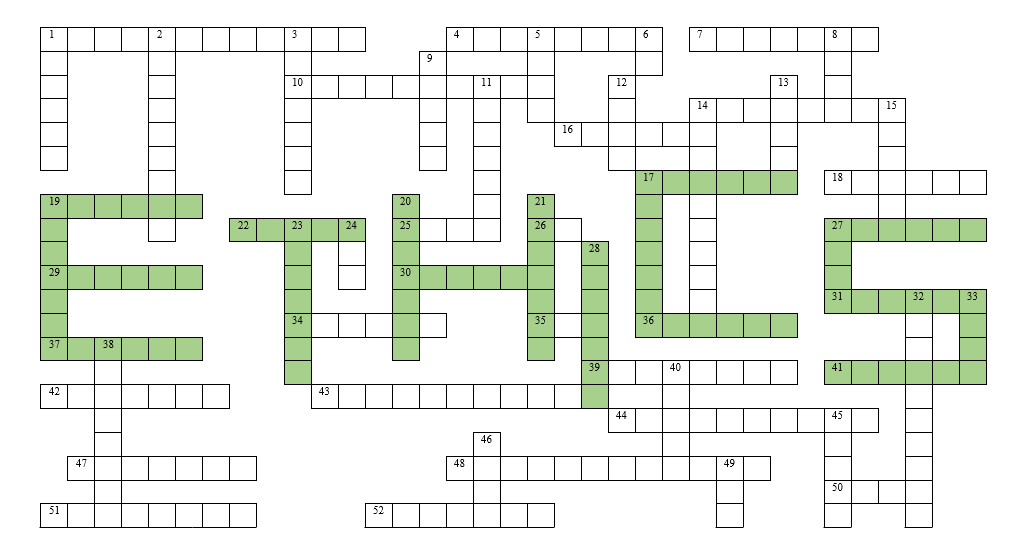
Across
1. Restricted to persons with permission/authorization, secret/undisclosed information, such as personal data collected from individuals (12)
4. Established by authority or custom as acceptable; the normal requirement (8)
7. Bearing or conduct that indicates self-respect and perception of others’ esteem (7)
10. Capable of being attacked, injured, or hurt, physically, psychologically, or socially due to characteristics leading to sensitivity and low adaptive capacity (10)
14. and 21 Down Conveying details of the research or treatment procedures proposed to be undertaken, assuring transmission and comprehension, and obtaining the participant or patient’s permission for them (8, 7)
16. Physical or psychological injury that may have long-lasting effects (6)
17. A specific response by an individual to a physical, mental, or emotional stimulus, which disturbs the individual’s equilibrium; required in optimal doses to ensure interest, growth, and development, but may overwhelm an individual’s bodily and psychosocial resources when excessive (6)
18. In low-risk situations that do not endanger participants, and in emergency situations, when participants or patients cannot be conferred with, a health professional or researcher may assume this relinquishment of 21 Down and proceed with the treatment or research (6)
>19. [pl.] Just claims, upheld by law and society, with responsibilities to balance them; a researcher should interact with research participants using this lens (6)
22. Distinction between good and bad, made by society rather than legislation; also the lesson to derive from experience (5)
25. Exposure to the chance of injury or loss, this needs to be made clear to every potential participant in a study or treatment procedure (4)
26. See 39 Across and 38 Down
27. Part of professional and ethical practice is to ensure explicit ______ for everyone who contributes to a piece of work, such as a study or a paper (6)
29. The effect produced, or impression made, by a project, an idea, or persons (6)
30. [pl.] The attitudes, behaviours, and social structures towards which people have a deeply ingrained positive or negative regard—preferences and behaviour are guided by these, not just by knowledge (6)
31. Not subject to a particular obligation, such as tax; some research protocols may not warrant detailed evaluation for human participant interactions and are thereby ______ from assessment by a board (6)
34. The quality of being fair and just, especially ensuring special consideration to those facing disadvantages (6)
35. See 6 Down and 43 Across
36. The opportunity or means to use something, e.g., healthcare services (6)
37. The stain or badge of disgrace applied to some on the basis of a discriminatory judgement of a social or biological characteristic (6)
39. and 26 Across and 38 Down This clash may occur, or seem to occur, between several of an individual’s preferences, predilections, or loyalties, and is best declared proactively (8, 2, 8)
41. Actions used to coerce someone to do something that they do not wish to, persons may agree to undergo research or treatment procedures under this rather than of their own volition (6)
42. A detailed examination following death, it may be a visual physical one performed by a coroner, or a verbal one performed by an investigator (7)
43. See 6 Down and 35 Across
44. Presenting someone else’s work (thoughts or outputs) as one’s own, without acknowledgement to the original creator (10)
47. A welcome, good, or helpful effect, it should be made available fairly just as burden should be distributed fairly (7)
48. Protecting from harm by preventing abuse, neglect, bullying, harassment and exploitation, and acting promptly to address such concerns (12)
50. Ironically it may not be proper to use the ‘proper’ category of this in dissemination of information (4)
51. Self-governance, making decisions for oneself, a core principle of bioethics (8)
52. A difficult situation, a quandary, which one may find oneself on the horns of (7)
Down
1. Opportunity to select, and the option selected (6)
2. Adherence to principles, a whole and unimpaired state (9)
3. Not based in truth, fact, or logic; hence weak or indefensible; an infirm individual (7)
5. Necessity, obligation, or lack, the driving force of research and treatment protocols (4)
6. and 35 Across and 43 Across The directive to healthcare professionals to refrain from active measures to revive an individual (2, 3, 11)
8. Increasingly research is conducted collaboratively, with persons with complementary domain expertise and skills coming together as a ____ rather than by individual investigators (4)
9. Confident expectation or reliance, between healthcare providers and recipients it smooths the path to improved health (5)
11. A store of biological samples for research into genetics and epidemiology (7)
12. A preconceived or unreasoned tendency or opinion, numerous checks of technical aspects of a protocol seek to minimize this (4)
13. [pl.] Behaviour patterns expected of each member of a social group, these expectations as well as people’s motivation to comply with them should be taken into account when conducting research (5)
14. A disorder or injury caused in the process of medical treatment, literally by a physician (10)
15. To conclude, judge, or determine, this is what a potential participant does when presented with the option of taking part in a study (6)
17. Secret, not discussed publicly, from the use of a particular flower at meetings to symbolize sworn confidence, a practice with origins in mythology (3-4)
19. [pl.] What an institutional ethics committee or board conducts of protocols to approve or correct the conduct of research and practice (7)
20. Personal, not meant for public expression, consumption, or display (7)
21. See 14 Across23. Esteem due to every individual, a cardinal principle of bioethics, also advocated strongly by activists such as Aretha Franklin (7)
24. Principle or regulation established by an authority and applicable to people in a community or nation and stated in governance documents (3)
27. A set of standards, or a cipher (4)
28. Fair treatment of all, including equitable distribution of resources, participation in decision-making, and administration of rewards and punishment (7)
32. In dealings with others, while one may aspire to beneficence (doing good), it is even more important to avoid being this, and causing 46 Down (10)
33. [pl.; more than just clothing accessories] Bonds or connections among people, influences on decisions and behaviour (4)
38. See 39 Across and 26 Across
40. Deceit, dishonesty, or breach of confidence, perpetrated to gain an unfair advantage, researchers are obligated to avoid this in interactions with study participants (5)
45. In making and officially owning a decision, one is assumed to be of this kind of mind, and declares it in writing (5)
46. Damage, of a physical, economic, social, or emotional nature [See also 32 Down] (4)
49. [abbr.] a legal contract in which parties agree to keep information protected for a specific amount of time (1, 1, 1)
Solution: View the solution to the Crossword
Author: Josyula K Lakshmi (jklakshmi@iiphh.org, https://orcid.org/0000-0002-9141-7324), Professor, PHFI Institute of Public Health Sciences Deemed to be University, INDIA.
Conflict of Interest: None declared Funding: None
Acknowledgement: The setter is grateful to the students of the MPH 2024-2026 batch at the PHFI Institute of Public Health Sciences Deemed to be University (formerly Indian Institute of Public Health, Hyderabad) for piloting this crossword in the course of their preparation for data collection on their MPH projects.
To cite: Lakshmi JK. (Cross)roads: a crossword on health research and practice ethics. Indian J Med Ethics. Published online only on September 7, 2026. DOI: 10.20529/IJME.2026.054
Submission received: July 13, 2026
Submission accepted: September 1, 2026
Manuscript Editor: Olinda Timms
Copyright and license
©Indian Journal of Medical Ethics 2026: Open Access and Distributed under the Creative Commons license (CC BY-NC-ND 4.0), which permits only noncommercial
and non-modified sharing in any medium, provided the original author(s) and source are credited.